Showing posts with label medicine. Show all posts

Strange TCM #5: Sea horses, the oceanic aphrodisiac

Every time I pass by one of those classic Chinese pharmacies, I can't help but stop and wonder... And a few months ago, I decided to find out. This is the final part in my "Strange TCM" series, following "eating snake for healthier skin," "eating ants to keep that lustrous hair," "deer penis will keep you strong" and "how to eat fried worms (and why it's so popular in China)"...

I ended part four of the series with Farmer Yu's favorite recipe for earthworm soup -- a disgusting thought, but he claimed it tastes better than pork soup.  Pork soup, which is often served with sea horses inside.  It apparently masks the salty taste.
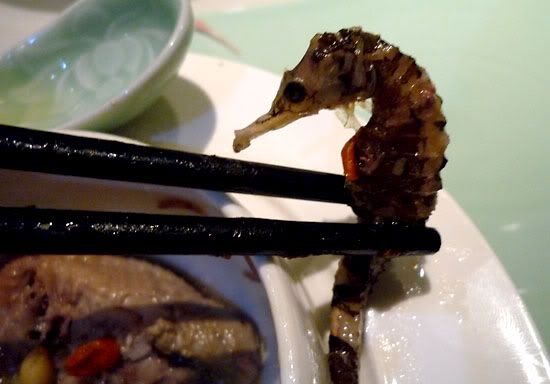

Now I've eaten sea horse, and it was pretty nasty.  Little sharp bits get caught in the teeth, the gums, and there's a nauseating salt taste to it.  Plus, they just look weird.  Like little bone beasts.

Most of China disagrees with me, though.  Here, they're as popular as ginseng.  And just like ginseng, they're used to enhance a man's... well, virility.  They also reinforce the kidneys’ yang, I'm told.

As the raunchy old Guangxi saying goes:

“Eating sea horses keeps that 80-year-old granddaddy young.”
“Chang chi haima, bashi gonggong lao lai shao.”
“常吃海马,八十公公老来少。”

One legendary fan of them (they're fishes, you know!) was Emperor Tangminghuang, one of the most popular emperors of China. He ruled from 712 to 756, and drank sea horse-infused liquor in his later years. This was hundreds of years ago, of course, but the fish remains a bestselling tonic.

Professor Lu Yannian, who works at a Chinese O.A.P. research facility, recommends it for middle-aged couples looking to spice up their sex life.

Neil Zhong, an overseas Chinese, buys his sea horses in Hong Kong and then eats them in the UK. He looks 30.  He is 50.

“Exercise and sea horse wine are my secrets,” he laughs.

Every night he drinks a small glass of top-shelf whiskey, with the sea horses in the bottle.  After the last pour, he chews up the fish. It’s salty, and has the consistency of squid, but these fish will costs up to US$750 a kilo.

Others will cook it into a soup with pork and dates--like Woo and I tried--or stew it with pig’s kidneys. It might be best, though, just to take it ground into a powder, then served in capsule form.

Also, I hear it's not a fast cure.  Dr. Tang Shulan says, “This isn’t Viagra. It’s a tonic. You have to take it regularly, and don’t expect to see effects in a short time.”

Dr. Bai Xiaofeng bought four, ate them, and saw no effect at all. “Rich people can afford more,” he said, “but I can’t.”

Sea horses are not only expensive, they’re also at risk: it’s reported that 20 million a year are sold for TCM purposes alone. They’re protected in China, and only legal when farmed—not when caught in the wild. So before you stay up all night doing coke and sea horses, stop and think about it.

Maybe you should try ants instead.

Much of this blog post is directly lifted from an article I wrote a few months ago, with research by me and my friend Chloe Chen, and published in my magazine, "The World of Chinese."  You should buy the magazine--subscribe to it, in fact!  It's quite awesome.

Strange TCM #4: How to eat fried worms (and why it's so popular in China)

Every time I pass by one of those classic Chinese pharmacies, I can't help but stop and wonder... And a few months ago, I decided to find out. This is part four in the "Strange TCM" series, following "eating snake for healthier skin," "eating ants to keep that lustrous hair" and "deer penis will keep you strong"...

Just like the baijiu-soaked deer penis, earthworms are a legendarily royal remedy here in China.  They're not even called worms, but something far more royal: Earth Dragons (地龙).

It all started with Emperor Taizu of the Song Dynasty, who ruled China from 960 to 976. Apparently, he had a wretched case of shingles. All of the royal physicians were baffled and no one could find a cure.

No one, that is, except a simple folk doctor.  He plucked a couple of earthworms -- sorry, earth *dragons* -- from the ground, moistened them with honey and sugar, and left them on a plate to melt in the sun. Gross, I know, but bear with me.

First, the folk doctor wiped the shingles with this dragon balm, and Emperor Taizu discovered cool relief for the first time!

Next, and this is where it gets really nasty, the mad doc made up a bowl of earthworm juice, and fed it to the emperor.  And just a few days later, he was completely healed.

“Let these magic creatures be herewith known as Earth Dragons!” the emperor proclaimed.  Or something to that effect.

Li Shizhen, the amazing doctor from the 1500s who I've written about in earlier sections, was also a firm believer in the earthworm.  In his "Compendium of Materia Medica," he wrote about how the creature can clear internal heat, nourish the lungs and calm asthma, as well as heal aches in joints. And, of course, cure skin problems.

Chloe talked to Dai Wenjuan, a traditional Chinese medicine expert at Shanxi TCM University, who explained that earthworms are still a popular treatment in China. “They can be applied both externally and internally,” she said. “Eating earthworms can treat asthma, swollen joints and rheumatic arthritis. Externally, it will stop allergic skin reactions.”

Dragon Farms

Yu Fenghai started his first earth dragon farm, Guangxi Bohai Earthworm Cooperative Society, five years ago in a small village in Guangxi. “We churn out 500 kilos of earthworms every day,” he boasted, explaining that his customers were mostly pharmacies and medicine factories.

At a pharmacy, one kilo of dried worms goes for about $14.

Guangxi is a real earthworm hotspot, it turns out.  Not only is there wild dragon farming, but also a lot of earthworm eating. Down there, you can find them everywhere: in booze, pancakes, even stir fried with veggies.

A generous man, Farmer Yu even let us in on his favorite recipe of all: Earth Dragon Soup.

Earth Dragon Soup

  • 7oz earthworms
  • 2oz ginger, smashed
  • vegetable oil
  • 1T rice wine
  • salt 
  1. Fry up the earthworms with the ginger in a pan with oil. 
  2. Add the rice wine and 2-1/2 cups of cold water, and let it boil for half an hour. 
  3. Add salt to taste.
I have to admit, I haven't tried this yet.  I haven't even tried eating worms.  (I haven't been to Guangxi...  that's the only reason...  I promise.)  But Yu insisted a bowl of this will improve your circulation and soothe any asthma. "And what’s more," he said, "it tastes nice—even better than pork soup!"

I believe you, Farmer Yu.

Much of this blog post is directly lifted from an article I wrote a few months ago, with research by me and my friend Chloe Chen, and published in my magazine, "The World of Chinese."  You should buy the magazine--subscribe to it, in fact!  It's quite awesome.

Strange TCM #3: Eating a deer's penis... some people swear by it!

Every time I pass by one of those classic Chinese pharmacies, I can't help but stop and wonder... why on earth would someone eat this madness? A few months ago, I decided to find out. This is part three in the "Strange TCM" series, which I started with "eating snake for healthier skin" and "eating ants to keep your hair"...

Snake seems so sleazy, and ants are gross. So much nicer than either of these? A young, innocent deer. That's one of the most common sights in a Chinese pharmacy, and when you see one stuffed, it represents longevity, happiness, luck and benevolence. And every single part of that benevolent deer is valuable.

Screwing the horns back in, at a neighborhood pharmacy.
The antlers are sold in elaborate gift boxes, almost like moon cakes. They’re not eaten whole, but ground up and mixed with warm water, until the combo becomes a thick glue, called Deer Antler Glue (鹿角胶, $10 for 250g). Apparently it'll tone your kidney, remove meridianal obstructions, help produce breast milk, and—like so many of these remedies—boost the libido. It balances the pairing of yin and yang, and even helps women with menstrual troubles.

Only a few places in China can make Deer Antler Glue, and one of those is the ancient Beijing pharmacy, Tongrentang. The shop opened for Beijing business eight years after the start of the Qing Dynasty, in 1669, and has been operating at the same location since 1702.

Recipes and more, after the jump...


北京 TCM Museum's deer embryo
Tongrentang is a TCM institution,  and it's aisles are staffed by very professional looking young ladies dressed in medical suits. Its cabinets, as well, are filled with a world of wonders: sea cucumbers, sea horses, and snakes. One thing I couldn't find there, though, was deer embryo.

The embryo is used as an ancient remedy for women having trouble getting pregnant. According to Chen Shiduo's 1691 book "The New Materia Medica" (本草新编), eating a deer's embryo will "invigorate the function of the spleen, reinforce kidney yang, tonify qi, and produce vital essence."

It’s also extremely hard to find.

"All the embryos have already sold out this year," Dr. Bai Xiaofeng told us. He’d spent months trying to find one for his daughter to eat. It took failed attempt after failed attempt, and the use of all his personal connections, to finally get his hands on one.

"I asked my daughter to eat three spoonfuls of the ground-up powder a day," he offered up. "She didn’t like it—it smells so bad. But she was pregnant by the third week. I asked my wife to finish the rest. You see, deer embryo is expensive, and not a speck should be wasted."

The owner of Zhaofeng Deer Farm didn't want her name printed -- she wouldn't even tell it to us -- but she enthusiastically agreed with Dr. Bai. "Deer embryo is especially good for women," she said. "Men can take it as well, as a tonic."

But the best tonic for men, she said, actually comes from a male deer.  The, ahem, deer loin.  Okay, I mean penis.

Penises are used a lot in Chinese med. The basic concept is that you can improve any part of your body by eating that same part from an animal. "You are what you eat," or in Chinese, "eat something, nourish something." (吃什么补什么。 Chi shenme, bu shenme.)

Today, deer willies are priced for the gentry (a 100g knob costs $60), and are recommended mostly for the older set. "Young men should leave it to their elders," said Xie Chongyuan, a professor at Guangxi TCM University. "They should focus on a healthy lifestyle, not on drinking tonics."

But if you do want to prepare this healthy tonic, cut the penis into thin slices, and soak them in a liter of strong alcohol (Chinese baijiu works well) for about two weeks. Twenty milliliters of the pecker-liquor a day should be enough to help the adrenals, boost testosterone, and improve... function.

In ancient times, this was a legendarily popular tonic for the emperors. But then again, they had so many wives, and all those concubines. Aish. They probably needed a helping hand.

Much of this blog post is directly lifted from an article I wrote a few months ago, with research by me and my friend Chloe Chen, and published in my magazine, "The World of Chinese."  You should buy the magazine--subscribe to it, in fact!  It's quite awesome.

My doctor's incredible office design...

I'm not sure what's more disturbing: this doctor's office interior decor sensibility, or the fact that I still let her dig around in my ear canal.  (The camera is pretty exactly vertical.)

Strange TCM #2: Eating Ants to Keep That Sweet Hairline

Every time I pass by one of those classic Chinese pharmacies, I can't help but stop and wonder... why on earth would someone eat these crazy things? A few months ago, I decided to find out. This is part two in the "Strange TCM" series, which I started last week with "why people eat snake for healthy skin"...

It turns out that, compared to $3000 snake penises, ants are a real bargain at just $30 a kilo.

But who in their right minds would eat ants? Maybe the happiest emperor in the history of China, Emperor Qianlong? He died just before the 19th century began, at the pretty insane age of 89, and blamed his good looks and eternal youthfulness entirely on his diet of ants.

This was the best photo I could get of ants... Someone bought these from the local pharmacy. 

He was inspired by Li Shizhen's "Compendium of Materia Medica," which was then already 200 years old, but was still the most popular medical book in China. (It remained the most popular until 1959!) In it, Doctor Li wrote that black ants "enrich the qi, beautify skin, delay ageing and restore kidney energy."

The emperor's favorite recipe is still an all-time Chinese classic: ants fried with pine nuts. I've never seen it on a menu, but I'm still looking -- it's supposed to be the best way to ingest them. If you want to make it at home, deep fry 50g of black ants in vegetable oil until they become crisp, then do the same with 300g of pine nuts. Now toss them in a pan with 20g of vegetable oil, and stir it all together. Add some salt and sugar, and dig in!

Before you go out and buy ants, though, be warned that the bigger they are, the more expensive they’ll be. Plus, as with anything, organic (aka wild) ants cost more than farmed ones. (Do they have ants at the Park Slope co-op?) The most expensive, though, is the legendary mountain-dwelling Wild Black Ant, which costs a whopping $45 a kilo. (Okay, that's only 50% more than the common black ant, but... well... maybe that's a lot in the ant world.)

To catch this beast, there's a world of professional hunters who spread ground-up bones on plastic sheets, which they then sprinkle with vinegar. They wait (presumably in hiding, I picture them dressed as giant ants) for half an hour, maybe an hour, after which a line of huge ants will start to appear. The show ends when these merciless ant assassins snatch them up, drop them in a bucket of water, and drown them. After a few days in the sun, they’re ready to be eaten.

Li Yanjun isn't a hunter -- he's a farmer -- but he's farmed and sold ants for a decade. He talks like an entomologist businessman. "Ants are nutritional, medical and healthy," he says. "They’re also one of the most valuable insects in China. The ant business has exploded in recent years. People realize that it's a good medicine. Looks disgusting, but it tastes nice if you cook it in the right way."

Which is, presumably, deep fried with pine nuts.

You can also soak your ants in liquor, like a snake. After a week, the ant-guotou cocktail will be drinkable, but the longer you wait, the better. Drink 40ml a day for arthritis, or perhaps as an aphrodisiac.

A pre-bottled version of this recipe, Yilishen Tonic Wine, was a huge seller across China a few years ago. It advertised itself as a natural Viagra, with the awesome tag line: "Those who use are those who know" (谁用谁知道!). Sadly, the company has since disappeared.

We found one guy who admitted to drinking a homemade ant cocktail, a Mr. Yan, but he wasn't too supportive of it at all. "I didn't see any effects," he said. "Plus, it was disgusting."

Granny Chen, meanwhile, eats ants for the same reason that Emperor Qianlong did: youthfulness. "Your hair will go from grey to black," she insists, telling a long rambling story about a friend who ate crushed ant powder for three years.

Cutting to the chase (and unlike Emperor Qianlong, presumably), Granny Chen uses her microwave to heat her dried ants, and she then blends them in a food processor. Two spoons a day, and she's still waiting for her hair to turn black... but she has high hopes. Her only complaint? "It tastes horrible, and smells like urine. It's disgusting, really."


Much of this blog post is directly lifted from an article I wrote a few months ago, with research by me and my friend Chloe Chen, and published in my magazine, "The World of Chinese."  You should buy the magazine--subscribe to it, in fact!  It's quite awesome.

Strange TCM #1: Eat Snake for a Smoother Skin

Every time I pass by one of those classic Chinese pharmacies, I can't help but stop.  You've seen them -- the deer antlers and sea cucumbers sold in gift boxes; the dusty owls perched above the counter; the ants, sea horses, and snakes in cabinets.  You can't help but wonder...  at least, I can't...  why on earth would someone eat these things? 

A few months ago, I decided to find out.  I bought some traditional Chinese medicine (TCM) books.  I drank snake booze.  I spent hours at Beijing's TCM university museum.  And I spent weeks asking questions of my TCM-expert friend, Chloe Chen.

Today, in the first of the series: why in the heck you might want to start eating snake...

Snake wine for sale in a Qingdao, Shandong Province pharmacy.

Wild stories, photos and recipes, after the jump!


Back in the Tang Dynasty, in the late 700s or so, an unnamed villager suffered from a terrible skin disease. His entire body was covered in boils and lesions.  Well into his adulthood, though, his skin started to unexpected clear up.  Everyone in the village was shocked.  "What did you do," his neighbors asked, "You look so good!"  "Nothing," the man replied, "But I have been drinking a lot of this wine, here."  In the bottom of the vat of wine they found a snake. A large, dead, rotting snake.  All of a sudden, the local doctors realized that snakes could perhaps clear skin diseases!

A thousand years later, in the 1500s, a doctor called Li Shizhen decided to investigate these wild claims.  He'd spent his life researching folk remedies like these, which he'd ultimately combine into a 52-volume medical textbook called "The Compendium of Materia Medica" (本草纲目).  The book was so well-respected that it remained the leading medical textbook well into the 20th century, and is used widely in Chinese hospitals today.  His takeaway?  Yes sir, snakes should be used to treat "stubborn dry scale-like skin diseases, skin eruptions and rashes."

Across China, and so much of Asia, you’ll still find snakes preserved in barrels and bottles of booze, everywhere.

At one restaurant in Qingdao, Lao Zhuan Cun, the manager is a man named Sui. His snake-bite is rice wine, infused with a gutted long-nosed pit viper. He also chucks in some heads of ginseng, and a handful of wolfberries, and lets it sit in a closet for a month.  A 50g glass of this goes for 18 RMB (about $2.75, half the cost of a Budweiser in New York.)

"Many people like it," Sui offered, "especially men."  I tried it.  I liked it.  It tasted like booze and it made me sleepy.  But it didn't do much else.

One farmer that Chloe talked to, Zhang Changmeng, had suffered from terrible arthritis his entire life. So he took to drinking snake booze, and was cured within two years.  So he claims, at least.  Being a snake farmer, albeit a TCM-certified one, I'm still not convinced. But someone clearly is: he sells sixty tons of snakes a year, at $60 a kilo, from his "Red Plum Snake Farm" in Shandong.

Snake head wine from a restaurant in Guangzhou, Guangdong Province.

"Snake powder not only helps with arthritis," Farmer Zhang insists, "but also eliminates toxins, clears your skin, and keeps you young."

If you want to make your own snake powder, the recipe is pretty simple. Gut and skin your snake, then bake it at a low, steady heat.  (Zhang wouldn't pass on the time or the temperature...  he said they were closely-guarded trade secrets.)  When it's "ready" (whatever that means), grind it in a mortar and pestle. I'm sure a coffee grinder would work just as well.  But be warned, it’s stinky.

A cheaper and easier way to ingest snake is ground and packaged. There’s a pill you can buy at any Chinese pharmacy called Vitiligo, for acne and other persistent skin problems, and another called Pure Zaoys, for lower back and leg pain.

For more specific problems, though, you'll have to dive deeper. The gallbladder of a Chinese rat snake, for example, is the size of a large soybean, and it's supposed to be great for bad eyesight. Farmer Zhang sells fresh ones for about 75 cents each. You can slice them into thin pieces, or grind them up.

The piece de resistance, meanwhile is the snake's, ahem, anatomy.  I found this jar of them in a Guangzhou seafood palace, where Michelle insisted they were mushrooms.  "Excuse me," I called over to a waitress.  "Is this a snake's weewee?"  (I used a Chinese word that translates directly as "Little Little Brother," and is used almost exclusively by small boys.)  She nodded, laughing, and walked off.


Snake penis wine, from a restaurant in Guangzhou, Guangdong Province.

I forget how much the restaurant was selling their snake penis liquor for, but from Farmer Zhang the weewees aren't cheap.  They're $3,000 a kilo.  But since they're sure to "warm the kidney" and "enrich your qi," maybe that's worth it.


Much of this article is directly lifted from an article I wrote a few months ago, with research by me and my friend Chloe Chen, and published in my magazine, "The World of Chinese."  You should buy the magazine--subscribe to it, in fact!  It's quite awesome.

Medicinal Sea Horse Soup

I adore TCM.  But I don't know what to say about this bowl of "Pigeon Soup with Chinese Medicine" we ordered last night at Gongti's Xuxian Lou (许仙楼的《川弓海马乳鸽汤》). Yep, that's a sea horse floating on top. 


I found myself eating around it, taking bites of dark red meats, chewing down foul beans, and sipping up the broth, saving the 海马 for the very last bite.  And...

oh, what a horrible, horrible bite it was.  Unbearably salty and fishy, and predictably crunchy, it broke apart quickly -- meaning so many more pieces to chew up.  I grimaced, but kept chewing, as sharp ends broke apart and found their way trapped between my gums and my lips.  It really was quite disgusting. 

Far more appetizing was this fantastic bowl of chicken atop a bed of pig's feet, which was so tender it broke apart at the touch of a spoon.  Most of all, I loved the way it was served... the chicken, covering herself up like a nurse might, confronted by Sid James in a "Carry On" movie. 

TCM 101: Cupping

When she heard about my plan to get cupped, my old battleaxe of a language tutor was furious. "How can you make games of this? This is not a game! It's serious!" And serious, it is. But it's also pretty damn cool. Cupping draws bad blood to the surface, stimulating blood flow and qi. In the summer, you see huge black welts on men's bare backs and women's upper necks throughout China. Apparently, they last for days.


Well, I felt like I needed a good qi fix, so headed to the local "all things TCM" clinic, where a dizzying menu of medical choices left plenty of new TCM ground to be covered in the months ahead. But first... the cups!


OCD in Hong Kong

Bird Avian Dog OCD Pork flu is raging across Hong Kong, and these signs are attached to absolutely everything. (I find it hard to believe they're really disinfecting that elevator every two hours...)