The Chinese Taxidermy Diaries: The Second Day

That first day was a trial.  We'd flayed a dog's legs, and worked the bones from the feet.  But that was nothing compared to the second.

"We've got two squirrels for you this morning," Teacher Liu said at breakfast.  I was thrilled -- a squirrel sounded like something I could do all of, myself.  But when Xiao Long pulled the animals out of the bag, they didn't look anything like squirrels.


"No, they're dogs," he said.  "Baby dogs. Their mother crushed them."  He pointed towards the giant Tibetan mastiff chained up in the courtyard.  She was gnashing and growling and tearing at the chain.  I think he was telling me she was the mother. I looked down, and felt like vomiting.

Teacher Liu walked in and then gasped.  "These aren't squirrels," he said. "Oh, well.  Just cut here." He used his finger to draw a line down the chest.  "Then you'll skin it."  I didn't like this one bit.

I delicately sliced through the skin, terrified I'd do something wrong, but Michelle gripped her scalpel like a dagger and plunged it into the dog's chest.  She pulled it towards her in one swift motion, like seppuku should be done.  And, like with seppuku, the blood was followed by guts and intestines, pooling over the body.  "Um.... Do you think I did something wrong?" she asked, reching for a roll of toilet paper and mopping it up.  It seemed endless.  "Swab, swab!" she said.

But once I buried myself in the act, when it went from being a dead infant pup to being a series of tasks, the horror faded.  It was a lot like preparing a rabbit for dinner.  (If that rabbit's 200lb foaming-at-the-mouth mother was watching you through the window, of course.) 

"This is kinda therapeutic," Michelle mused.  Sure, if you were a serial killer.  But then again, I kept thinking the thin strips of flesh I was skinning off looked like parma ham.  It made me feel hungry.

By lunchtime, when the dogs were skinned and massaged in salt, I felt like a professional.  Even if I'd been completely unable to work the cartilage from the ear.  And mutilated both ears in the process. At least I didn't cut off the dog's tail, like Michelle did.

"Don't worry," said apprentice Xiao Long.  "These are just for you to learn with.  Do you drink liquor?"  He held up a small plastic water bottle, filled with yellowish liquid.  Bits were floating in the liquid.  "This is Chinese baijiu.  This has snake in it, and other things, too."  He offered it to me.  I refused, and he took a sturdy pull. 

"How much can you drink?  I mean, how many jin of liquor?"  A jin is half a kilo.  I didn't have any idea how many I could drink, and I told him so.  "Oh.  I can drink one and a half jin.  But not every day.  Every day, my father drinks one jin."

In the afternoon, we worked more on the dogs, taking breaks to brine yesterday's dog skin, sew up cuts in the skin, learn to mount a caribou's antlers correctly (it took us 2-1/2 hours, with six people somehow involved), and explore the village.  Every alleyway, people stopped to stare at us.  Evidently, not many foreigners come to this village.


Strange TCM #5: Sea horses, the oceanic aphrodisiac

Every time I pass by one of those classic Chinese pharmacies, I can't help but stop and wonder... And a few months ago, I decided to find out. This is the final part in my "Strange TCM" series, following "eating snake for healthier skin," "eating ants to keep that lustrous hair," "deer penis will keep you strong" and "how to eat fried worms (and why it's so popular in China)"...

I ended part four of the series with Farmer Yu's favorite recipe for earthworm soup -- a disgusting thought, but he claimed it tastes better than pork soup.  Pork soup, which is often served with sea horses inside.  It apparently masks the salty taste.


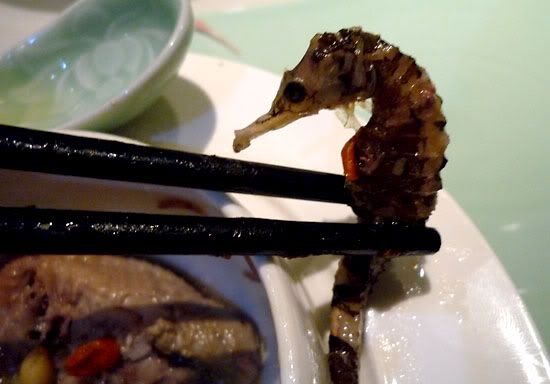
Now I've eaten sea horse, and it was pretty nasty.  Little sharp bits get caught in the teeth, the gums, and there's a nauseating salt taste to it.  Plus, they just look weird.  Like little bone beasts.

Most of China disagrees with me, though.  Here, they're as popular as ginseng.  And just like ginseng, they're used to enhance a man's... well, virility.  They also reinforce the kidneys’ yang, I'm told.

As the raunchy old Guangxi saying goes:

“Eating sea horses keeps that 80-year-old granddaddy young.”
“Chang chi haima, bashi gonggong lao lai shao.”
“常吃海马,八十公公老来少。”

One legendary fan of them (they're fishes, you know!) was Emperor Tangminghuang, one of the most popular emperors of China. He ruled from 712 to 756, and drank sea horse-infused liquor in his later years. This was hundreds of years ago, of course, but the fish remains a bestselling tonic.

Professor Lu Yannian, who works at a Chinese O.A.P. research facility, recommends it for middle-aged couples looking to spice up their sex life.

Neil Zhong, an overseas Chinese, buys his sea horses in Hong Kong and then eats them in the UK. He looks 30.  He is 50.

“Exercise and sea horse wine are my secrets,” he laughs.

Every night he drinks a small glass of top-shelf whiskey, with the sea horses in the bottle.  After the last pour, he chews up the fish. It’s salty, and has the consistency of squid, but these fish will costs up to US$750 a kilo.

Others will cook it into a soup with pork and dates--like Woo and I tried--or stew it with pig’s kidneys. It might be best, though, just to take it ground into a powder, then served in capsule form.

Also, I hear it's not a fast cure.  Dr. Tang Shulan says, “This isn’t Viagra. It’s a tonic. You have to take it regularly, and don’t expect to see effects in a short time.”

Dr. Bai Xiaofeng bought four, ate them, and saw no effect at all. “Rich people can afford more,” he said, “but I can’t.”

Sea horses are not only expensive, they’re also at risk: it’s reported that 20 million a year are sold for TCM purposes alone. They’re protected in China, and only legal when farmed—not when caught in the wild. So before you stay up all night doing coke and sea horses, stop and think about it.

Maybe you should try ants instead.

Much of this blog post is directly lifted from an article I wrote a few months ago, with research by me and my friend Chloe Chen, and published in my magazine, "The World of Chinese."  You should buy the magazine--subscribe to it, in fact!  It's quite awesome.

The Chinese Taxidermy Diaries: The First Day

"Was he killed?" asked Xiao Li, as he was carefully slicing around the ear, trying to get at the tendon inside.
"No," said Teacher Liu.  "He just died a few days ago."
"Died of what?"
"I don't know.  Don't ask me."
"He must have died of something."
"He just died.  He was old.  Really old."
"Was he a pet?"
"Yes.  But he's a fairly large dog.  So probably a guard dog."

The guard dog, who may have been a pet, was laid out in front of us.  The air was rancid.  My hands were disgusting.   We'd spent the morning flaying him.  We salted him before lunch.  And now, we were scraping the flesh from the skin.  Three of us students each worked on a paw.

I knew we'd have to stuff a dog the first day of Chinese taxidermy school.  I just knew it. 

Chop knew it, too.  She growled at me when I came back to the small room we're staying in for the next few weeks.  I'm sure she smelled the flesh of the dog I'd been scraping all day.  I fed her from the table, to try to win her back, but when I felt her paw in my hand, I couldn't help noticing the feeling of fat -- fat I'd just scraped from the guard dog's paw.


"Have you experienced eating dog?" joked Xiao Long.  The other students shook their heads, disgusted.

I admitted I had.  Then I elaborated: "Three times." 

The others looked horrified, and glanced at Woo for confirmation.  She admitted that she had, too.

"I don't eat dog," said Xiao Long, "but we kept the rest of the meat, if you want it.  It's in the freezer.  You can eat it later.  I like hamburgers.  I once ate eight for one meal."

"Eight?"

"Yes, my friend paid for it."

Xiao Li, who'd wanted to know how this dog died just in time for the class, was still trying to slice the cartilage from the ear.  It was frustrating him, but he wouldn't give up.  He's given up just using a scalpel, and was using a wooden tongue depressor, a pair of scissors, a metal dental pick, and a handful of other unrecognizable tools.  He was clearly making no progress.

"Let me do it," said Xiao Long, who's been apprenticing under our teacher for two years.  He was bored of the pile of goat heads he was scraping away at.  They were for a project for a famous artist, someone Woo's a fan of, who's been ordering them painted yellow and perched on wildly inflated bodies.

"I can do it myself," Xiao Li insisted.  Xiao Li been working at a zoo in Harbin, far up north, for 11 years already.  He'd trained both tigers and bears, and he stuffed animals with a passion.  He hadn't even taken off his brown imitation-leather jacket since sitting down this morning.  He wasn't about to let a beginner show him up.

It was another half-hour before he finally gave in. 

"Okay, you try," he said, tossing down his scalpel.

Xiao Long sauntered over with a pair of plyers.  He made a few slices, shoved the plyers in, and wrenched the inch-long piece of cartilage in one go, and tossed it across the table.  He was the taxidermy shit.  He recognized it, then went back to his pile of goats heads.  Xiao Li sat down in his chair again, picked up his scalpel, and went to work on the other ear.

I wasn't so adept at using the scalpel.  Xiao Han, who's been stuffing for eight years as a taxidermist at Beijing's Natural History Museum, gave Woo and I tips.  "Hold it like a pen," he said.  But his slices were filled with years of confidence.  Our slices were hacks and saws, leaving holes riddled in the skin, fur poking in from the outside. 


But at least I didn't throw up, which was my main concern.  When I was ten, I fainted while we were dissecting frogs.  The teacher made me sit outside for the rest of class. 

Woo, meanwhile, embraced it.  She yanked the finger bones out of the paws, far faster than I did.  She laughed maniacally when she realized the paw she was fleshing -- the fifth paw -- was actually the dog's penis.  Later, she ducked under the table with a squeal.  "Oh look, another animal," she cried, digging through a pile of plastic bags excitedly.

I wanted to take a picture, but my hands were too covered in salt and grease and gross.  Plus, I was bleeding.  I didn't realize how sharp those scalpels are.

You probably don't want
to click to enlarge this pic.

But this one of Xiao Li and a dried caribou is kinda cute.

Off to Taxidermy School

Woo and I have long shared a love of stuffed animals, so it's time to make it true. This morning, we're driving off to Songzhuang Artists Village with two lads from Harbin for a 10-day taxidermist training workshop.

A couple of Woo's preview snaps, from our visit last weekend. I just hope my stomach proves to have strengthened since my 7th grade biology class.


Soy Sauce-Flavored Kit Kats, and other bizarre Nestlé mashups

I was a little confused about the Tokyo airport when I flew through there a few weeks ago. It seemed so... rundown. Ceiling tiles missing, chairs blocking entrances, stores closed. And then I saw this sign. Uh-oh. What had I missed during my media blockout?


Turns out the third reactor was about to go, so I did what any slightly-nervous very-jetlagged consumer might do. I bought Kit Kats. Lots of them.

You probably already know that Kit Kats are the lucky treat in Japan. The local name for them, kitto katto, sounds an awful lot like the pre-exam expression of goodwill, "kitto katsu," which means "win without fail." (Sweep the leg, Johnny!) So they've got a lot of them. Before every exam, everyone gives out kit kats. Woo tells me there are 80 200 different flavors.

Sadly, Narita only had six. But I bought them all.

They're cute... some of the boxes even have space to write notes or love letters to your friends. I wish Starbucks had that, too. I'd write a letter to myself every morning. Now that would be fun.


Anyway... the taste test!

Green Tea
Everything in Asia is available in green tea flavor. Ice cream, candy, toothpaste. At least this was dyed green. (This would be perfect for St. Paddy's Day, really.) Woo and I both loved it, but Tara wasn't so impressed. "It's like I dropped my kitkat in my green tea," she started, before revising, "no, it's more like I'm actually eating a dried tea bag. Ew."

Sakura Matcha Kit Kat
This one's a real treat -- it's only sold during springtime, presumably so you can gaze on the cherry blossoms while feasting on your connected sticks of chockie love. Sweet, milky, a little bit florally. "They say this thing, this magic we share together, came with the weather too," as Cherry Blossom Dearie once sang. It did. It's a Cherry Blossom Kit Kat.

Dark Chocolate Kit Kat

Oooooh.... sophisticated. "Now this," asserted Woo, "This is a Kit Kat for grownups." It's not too sweet, it's got depth, and flavor, and that little crunchy bit in the middle. Perfect! "I wouldn't give any away," said Tara. "It would match a Guinness or a coffee, perfectly."

Coke / Sprite Kit Kat


Ayaaaa! After the glory of the dark chocolate Kit Kat, this combo was just hideous. "I don't like that," said Woo of the Coke-, or cola-, flavored bar. It reminded me of those little bottle-shaped gummy bears I used to love as a kid, but I didn't love this one at all. The white bar did have the scent of Sprite, but it tasted like lemon-scented Windex. Chemical, false, and horrid. (I have to admit, though, that I finished the other two bars when Woo wasn't looking. Something about this pair kept drawing me back.

Soy Sauce Kit Kat


The one we all came for. It's a reduced-size white chocolate bar, with such a minimal hint of salt that almost no-one could taste it. (Although Ginger immediately asked, "Is it salt flavor?") It went down nice, soft and subtle.  "Is that all there is to it," Woo asked, disappointed.

But then, after swallowing the last bite, you could suddenly sense it on your breath. It felt like you'd just finished drinking a cup of soy sauce.  Not soy milk, but soy sauce.  "Oh god," howled Tara, "this is disgusting!" Ginger was furious with me. It was weird, and horrible. I yawned, and it was even worse.  Someone belched, then cried out, "Oh my god, I feel sick!"

I have a few bars of this left, if you'd like one... 

(*Thanks to all the volunteers -- Woo, Sof, Zac, Tara, Matt, Ginger -- that helped me and my run-down tastebuds identify what the hell was going on with some of these. Especially the soy sauce one.)

Modern Day Cavemen of Shanxi

Recently, Woo and I were in rural Shanxi Province, and noticed a series of caves carved into the landscape, off in the distance.  They were just dark shadows, really, but they were clearly man-made.


"Before, did people live there?" we asked the cab driver, like the good tourists that we were.

"Yes, but they still live there today," he laughed.  "They're called 窑洞."  Yaodong, a cave dwelling.

"Really?  Like Captain Caveman?"  He didn't understand the reference, at all.  I didn't even bother trying to fumble it into Chinese.  "Can you take us there?"

We were on the meter, so he did.  

Sure, people lived in caves in ancient times.  And I even remembered reading that Mao and his superpals had lived in Yan'an caves before liberation, but that was during war.  This was a peaceful time of expansion for China, and this was only about an hour's flight from Beijing -- the epicenter of it all.  How could this be?

But Shanxi wasn't Beijing.  Everything we saw was covered in grey dust.  Grim factories, harvesting coal, seemed to be the bulk of industry... they were everywhere. 

He took us down a dirt road, and through smaller and smaller villages, until we finally reached a cave village and convinced the skeptical locals to let us look around.


And you know what?  They were pretty nice!  Doors, windows, kitchens, electricity, goats!


"All of the young people have left," this old man said.  "They've moved to the city, and to normal houses.  But I like it here.  It's warm in the winter, and cool in the summer.  I've lived here for 60 years."

60 years?  As a farmer, he only looked about 60 years old.  He'd probably lived in this cave his whole life.  He kept two goats tied up outside his door, and had an incredible collection of corn ears in his yard.


These posters on his bedroom wall... that is, his only room's wall... weren't 60 years old, but they were pretty incredible. That's Wong Kar-Wai's starlet Maggie Cheung (Ashes of Time, In The Mood For Love, 2046) from her early days, on both the left and right.  From long before she'd even heard of Wong, and possibly even the Cannes Film Festival (which she'd later win, jury, and appear on the poster for).  At about this time, she was just a recurring cameo actress, playing Jackie Chan's girlfriend in his awesome Police Story films.

In the middle, the trio of lads are "Handsome Boys."  (No surprise there.)  Echo assures me they're not a pop group, but that "They are just three models." I find it hard to imagine my grandfather keeping that poster on his cave wall.

One of his neighbors, who lives down the path in a hundred-year-old cave dwelling, repeated the "warm/cool" mantra.  The inside of her house was very dark, but she did have two rooms to herself.

"For old people, this is comfortable," she smiled.


Then something clicked in her head. She turned to Michelle with a disapproving look, and asked, "Are you two together?"  She shook her head, when she heard we indeed were.

Outsider Art Kangaroos at the Beijing Zoo

I wasn't much impressed with the Beijing zoo.  Quite the contrary...  I was absolutely horrified. We left depressed.  (See this story for a hint of the madness.)

But on the upside, while we saw no live kangaroos, we did happen on these lovely grazing sculptures, made from pieces of found wood. It felt more like something you'd see made from North Carolina driftwood...

My favorite's the last one, so minimal, and so cute.


Now that's just rude...


(At the Beijing Zoo.)

Continuing on from yesterday's post, here are my six top favorite collections from Beijing's wonderful stamp and post museum.... Sorry for the spoiler above. But it's just... too weird.

6. Table Tennis
What's there not to love about table tennis?  Mao adored it, so did Deng Xiaoping and Zhou Enlai.  Plus, there's always the game to thank for opening those relations between east and west.  (Actually, I guess you could thank ping pong diplomacy for my even being here!)  You even occasionally find tables sitting hidden in the hutongs, the Chinese version of a basketball hoop in a car park, waiting for locals to walk up with their paddles and start a game.  Thus, a lovely trio of stamps dedicated to the popular sport.


1959 - 25th World Table Tennis Championships


1971 - Afro-Asian Table Tennis Friendship Invitational Tournament


1971 - Afro-Asian Table Tennis Friendship Invitational Tournament


5. Reforms and Opening Up, plus Scientific Knowledge
After the horrors of the cultural revolution, the closing of universities, the bizarre damning of education, a bright light shone on China in Reforms & Opening Up.  "I don't care if it's a white cat or a black cat. It's a good cat as long as it catches mice," said Deng Xiaoping, and these great stamps, from three separate series, all show off China's (then) newfound love for industry, technology, and the future.


9/13/1980 - Exhibition of People's Republic of China


1979 - Loving Scientific Knowledge from a Small Age


1984 - 35th Founding of the People's Republic of China - Springtime of Scientific Knowledge

4. Swimming
Basketball (oddly missing from the stamps) is China's favorite team sport. Table tennis is the favorite one-on-one sport. But when it comes to solo exercise, I'd bet it's all about the swimming.  Not competitive, but for the love of China.  See the movie "Girl Divers," where girls dive for Chinese Socialism.  And don't miss my good friend Ginger's wonderful article on swimsuit fashion in China.  These two gorgeous stamps were released on the 10th anniversary of Mao's famous final swim in the Yangtze River (at age 73!)  "However hard the wind blows and the waves hit," he wrote in a poem about it, "I feel like I'm taking a casual walk in a peaceful courtyard."  Lovely.  Here they are.


7/16/1976 - 
Be tempered in big rivers and seas.


7/16/1976 - 
Cross the Yangtze River


3. Post Conference
What was the first national postal conference? I can't tell you. All I know is it was in 1950, and this is one of the most beautiful stamps in the museum. It was designed, apparently, by Sun Chuanzhe. (I found one for sale for US$200.) The caption read something along the lines of "Postbox, means of transportation reach the map," which makes sense given the train, the ship, the map, and the pillar box. Just lovely.


2. Mao
Could I really leave Mao out of my favorite stamps from the museum? Surprisingly, there were very few, but this jaw-dropping 1948 beauty really caught my eye.  The caption reads something like "Mao in the East China liberated area." It reminds me of some comic book artist's studies, maybe R. Crumb's?...


1. DPRK
And the prize for the best stamp set at the China National Post and Postage Stamp Museum doesn't actually go to a Chinese stamp at all. It's a series we almost missed, that caught my eye from across the hall as we were walking out. "Is that a 3D stamp," I cried. It was. One of those old-school 3Ds, where from one angle you see a boat, and from another angle you see Donald Duck. Except this was different. This was from North Korea. And it was in tribute of Prince Charles, Lady Diana, and newborn Prince William. I'm serious. NORTH KOREAN STAMPS TRIBUTING PRINCE WILLIAM'S BIRTH, IN 3D?

They were accompanied by a caption stretching to two paragraphs -- far more than any other stamp -- which was entirely about the technology of these stamps.  Not at all about the weirdness of North Korea releasing stamps devoted to Prince William.

They were released on October 1st, 1982, which was 3 months after he was born, but right on the mark for my 10th birthday and the 33rd birthday of the People's Republic of China. I can find nothing on the internet about these puppies, but... well, they do exist.  [Talking to my dad, the legendary stamp collector, he was less surprised.  "Every country releases stamps like these, to make some money."  Hrm.  It's still damn weird.]

[I'm sorry the quality isn't great. Shooting in low light through plexiglas was bad enough for most of these, but then 3-D as well? Oh, man. They were absolutely jaw-dropping gorgeous. These pix don't do justice. You need to go, and see them yourself.]


These were all found at the China National Post and Postage Stamp Museum
Building D, No 6 Gongyuan Xijie, Dongcheng District, Beijing, China
Exit A, Jianguomen Subway